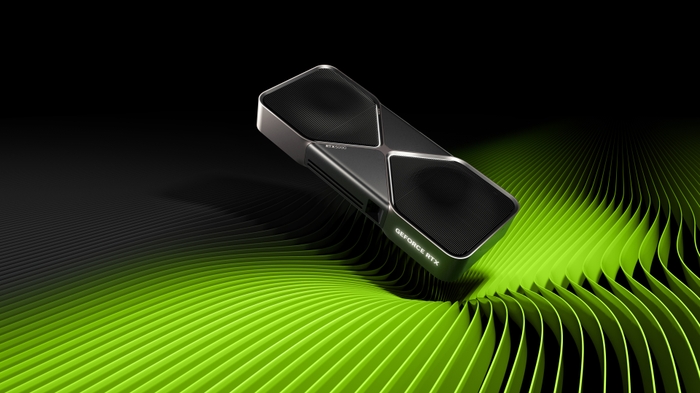
NVIDIA GeForce RTX 5090 Review
The undisputed king of consumer GPUs. The RTX 5090 delivers untouchable 4K performance, dominates ray tracing with 4th-gen RT cores, and runs DLSS 4 with multi-frame generation. With 32GB of GDDR7, it's also a beast for AI and content creation workloads. The catch: $1999 MSRP, 575W TDP, and you'll need a 1000W PSU minimum.
Architecture & Overview
The NVIDIA GeForce RTX 5090 is built on the NVIDIA Blackwell architecture, fabricated on a TSMC 4NP process and launched in 2025. It pairs 21,760 shading cores with 170 ray tracing cores and 680 tensor/AI cores, clocked up to 2407 MHz boost. The memory subsystem is 32GB of GDDR7 on a 512-bit bus, delivering 1792 GB/s of bandwidth — the data pipeline that ultimately determines how much of the card's compute can actually be fed in real-world workloads.
With a 575W TDP, the card draws power through 1x 16-pin (600W) and is rated for a 1000W minimum PSU. Physically it measures 304mm long and occupies 2 expansion slots — important sizing numbers to check against your case before buying.
Performance Breakdown
Ranked #1 of 15 GPUs in our database by 3DMark Time Spy score. The next card down is the NVIDIA GeForce RTX 4090 (~17.9% slower).
Real-World Gaming Performance
At 1080p you'll be CPU-bottlenecked in nearly every title — this card runs 1080p as an afterthought. 1440p is where it stretches its legs, pushing 144+ FPS in most AAA games at ultra. 4K is its real home: ultra settings at 60+ FPS in even the heaviest modern titles, and 4K high-refresh (120+ FPS) becomes routine with DLSS/FSR engaged.
Pros & Cons
What we like
- Elite rasterization (100/100) — among the fastest in our database
- Top-tier ray tracing (100/100) — dedicated RT cores handle heavy effects
- Massive 32GB VRAM buffer — futureproof for 4K and heavy content work
What to watch out for
- Very high 575W TDP — demands a premium PSU and robust case airflow
- Premium pricing at $1,999 MSRP
CPU Pairing Recommendation
This GPU belongs in a no-compromise build. Pair it with a top-tier gaming CPU like the AMD Ryzen 9 9950X3D to avoid CPU bottlenecks at 1440p. At 4K you have more flexibility — the GPU becomes the limiter and even mid-tier CPUs keep up.
Not sure if your pairing is balanced? Run the numbers through our bottleneck calculator to check.
Full Specifications
| Spec | Value |
|---|---|
| VRAM | 32GB GDDR7 |
| Memory Bus | 512-bit |
| Memory Bandwidth | 1792 GB/s |
| Boost Clock | 2407 MHz |
| Base Clock | 2017 MHz |
| CUDA / Stream Cores | 21,760 |
| Ray Tracing Cores | 170 |
| Tensor Cores | 680 |
| Process Node | TSMC 4NP |
| PCIe Interface | PCIe 5.0 x16 |
| TDP | 575W |
| Recommended PSU | 1000W |
| Power Connectors | 1x 16-pin (600W) |
| Length | 304 mm |
| Slot Width | 2 slots |
| Display Outputs | 3x DP 2.1b, 1x HDMI 2.1b |
| 3DMark Time Spy | 41,500 |
| Release Year | 2025 |
Best For
- 4K ultra gaming
- 8K gaming
- AI/ML workloads
- Content creation
Compare With Nearest Peers
vs NVIDIA GeForce RTX 4090
$1,999 vs $1,599
vs NVIDIA GeForce RTX 5080
$1,999 vs $999
vs NVIDIA GeForce RTX 4080 SUPER
$1,999 vs $999
Frequently Asked Questions
What PSU do I need for the NVIDIA GeForce RTX 5090?
What power connector does the NVIDIA GeForce RTX 5090 use?
How much VRAM does the NVIDIA GeForce RTX 5090 have?
Does the NVIDIA GeForce RTX 5090 fit in my case?
Is the NVIDIA GeForce RTX 5090 good for ray tracing?
Where to Buy the NVIDIA GeForce RTX 5090
The NVIDIA GeForce RTX 5090 launched at $1,999 MSRP. Real-world prices vary by retailer, partner card, and stock — we recommend checking Amazon for current pricing on Founders Edition and aftermarket models from ASUS, MSI, Gigabyte, and others.
View NVIDIA GeForce RTX 5090 on Amazon →